

Monthly tracking of injection molding machines and die casting machines (10): Focus on the sustainability of post-holiday recovery
We predict the demand for injection molding machines will remain flat/increase slightly month-on-month in January; the demand for large die casting machines will grow, with prevailing industry trends of integrated die casting to continue.
Comment
Injection molding machine: Demand will proceed normally at the beginning of the year, with attention to turn to sustainable recovery after the Spring Festival. On the basis of our recent study on equipment manufacturers, we predict that demand for injection molding machines will continue to bounce back weakly, as in the second half of last year, see a year-on-year increase, and remain flat month-on-month or increase slightly in January. In terms of industries, we predict that downstream of automobile industry demand will remain relatively strong as demand for daily necessities continues to recover. From the perspective of gross profit margins, we foresee a continuation of price competition stemming from a shortage of orders. Manufacturers at every level have adjusted prices to varying degrees, but a decline in the cost of raw materials (in about 3 months) may boost gross profit margins. In terms of high-frequency manufacturing data, manufacturing PMI in January was 49.2%, with a month-on-month increase of 0.2ppt, which is still in the range for contraction. As for other general equipment, the output of metal cutting machine tools/the output of industrial robots/forklift sales from January to December have increased by 6.4%, decreased by 2.2%, and grown by 12.0% year on year respectively, trending towards an overall recovery.
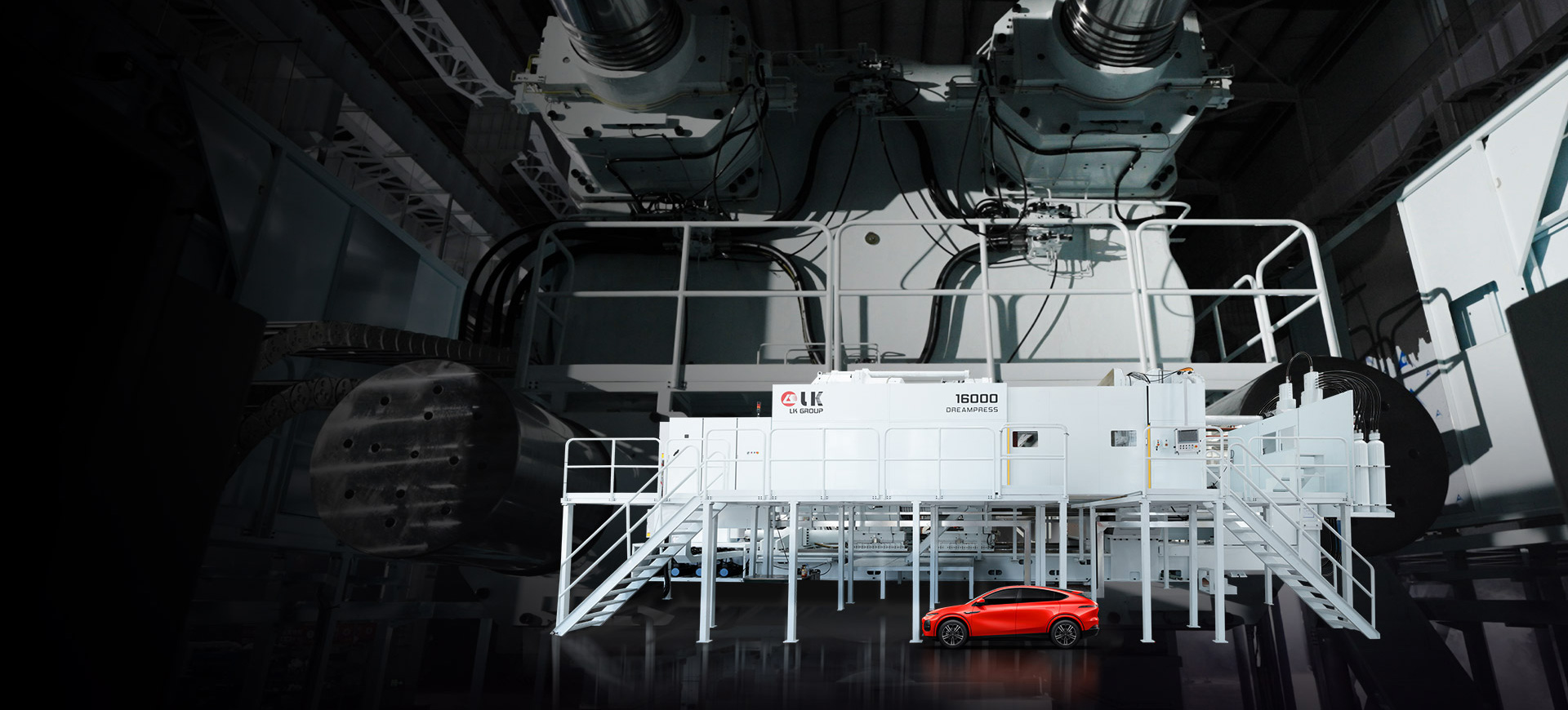
Die casting machine: XPeng Motors' 16,000T integrated die casting machine is expected to move into production in Q1, with LK's 20,000T dual-injection technology in development. As for the die casting industry, we predict that downstream demand for small die casting machines will mirror that of injection molding machines and bounce back somewhat while demand for die casting machines above 1,000T are more likely to remain up on the strength of lightweight vehicles.
A number of automobile models produced by integrated die casting were made public in December 2023 and early January 2024, including the NIO ET9, XPeng X9, Wenjie M9, Xiaomi SU7, Zeekr 007, and Neta models based on the Shanhai Platform. The application of integrated die casting by emerging carmakers has accelerated the industry trend. As for die casting equipment, XPeng announced the 12,000-ton integrated die casting machine provided by LK has been put into production on the XPeng X9 rear underbody. We expect the 16,000-ton integrated die casting machine to be put into production in Q1 this year. At the same time, LK announced in December 2023 its first collaboration with Neta on 20,000-ton die casting equipment and signed a contract with Chery Auto for the world's first 10,000-ton-plus dual injection process. YIZUMI has completed the development of 6,000 to 9,000-ton giga die casting machines and has already received 10 orders from customers. Small-batch trial production for the 9,000-ton die casting machine has wrapped up, and two 7,000-ton die casting machines were delivered to Changan Auto in late August 2023 (a total of 4 machines). We believe this marks a breakthrough in the company's cooperation with OEMs. YIZUMI China Wusha No.3 Factory was also put into production last year with an annual production capacity of 100 large and giga die casting machines, ensuring ample production capacity.
Valuation and Recommendation
We recommend that investors closely focus on the emergence of a turning point in downstream demand in the short term. In the long term, we are optimistic about competitive industry players such as Haitian International, YIZUMI and LK Technology Holdings Limited. We maintain our earnings forecasts, ratings, and target prices for the companies in question.
Risks
Demand for injection molding machines falls short of expectations with more intensified competition; penetration of integrated die casting technology fails to meet expectations.